
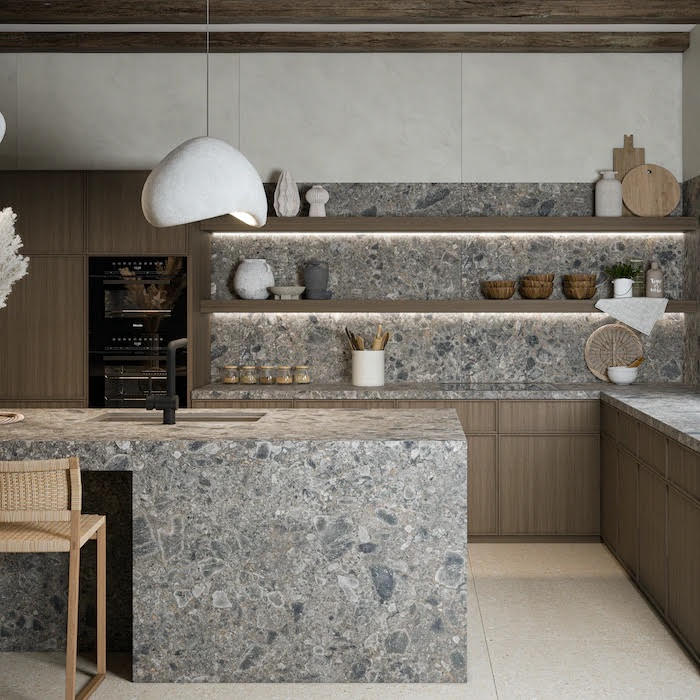
The way Americans define luxury in their homes has changed for good. The era of flashy materials with a hidden environmental cost is giving way to something far more sophisticated: a design philosophy where beauty and responsibility reinforce each other rather than compete.
Nowhere is this shift more visible than in the kitchen and bathroom. Countertops are the centerpieces of these spaces, and homeowners who used to equate exclusivity with rare stones quarried from the other side of the world are now asking a different question: what does it actually cost to make this surface, and what does it leave behind?
The answer has given rise to a booming market for eco-friendly countertops, and the options available today are genuinely stunning.
What Makes a Countertop Eco-Friendly, Exactly?
Not every product that markets itself as green deserves the label. Eco-friendly countertops take sustainability seriously across the entire lifecycle of the product: where the raw materials come from, how much energy the manufacturing process uses, whether harmful substances are released into your home, and what happens to the material when it eventually gets replaced.
That scope matters because a product can look green on the surface while having a problematic manufacturing footprint. The most credible eco-friendly options can point to third-party certifications, published environmental product declarations, and transparent sourcing practices.
There are three main areas where eco-friendly countertops differ from conventional ones.
- Health: Conventional engineered quartz contains high levels of crystalline silica and often incorporates polymer resins that can off-gas VOCs over time. Eco-friendly alternatives use low or zero silica formulations, non-toxic binders, and non-porous surfaces that do not harbor bacteria.
- Environmental impact: Manufacturing countertops is energy-intensive. The most sustainable brands have shifted to renewable energy sources, incorporated recycled materials into their formulations, and committed to carbon neutrality targets.
- Longevity: A countertop that lasts 30 years is inherently more sustainable than one that needs replacing after a decade. Durability is a real sustainability metric, not just a selling point.
Certifications That Actually Mean Something
When shopping for eco-friendly countertops, it pays to know which third-party certifications carry real weight.
- NSF Certification indicates that a product meets the National Sanitation Foundation’s food safety criteria. This matters for kitchen surfaces where food prep happens directly on the countertop.
- GREENGUARD Certification confirms that a product is a low-emitting material that meets indoor air quality standards, including in environments with sensitive occupants like children and the elderly.
- ISO 14001 demonstrates that a manufacturer has implemented a verified environmental management system. It covers the production process rather than the finished product.
- Cradle to Cradle Certified® evaluates products across material health, recyclability, renewable energy use, water stewardship, and social fairness. It is one of the most comprehensive sustainability frameworks in manufacturing.
- Environmental Product Declarations (EPDs) are published reports that document a product’s environmental impact based on a rigorous life cycle assessment. Brands that publish EPDs are putting their numbers on the table for independent review.
What Design Trends Are Driving Demand
The visual direction of high-end American interiors is pulling squarely toward materials that feel grounded, natural, and authentic. The all-white, sterile kitchen has run its course. Designers and homeowners are reaching for warm neutrals, soft beiges, terracotta tones, and deep jewel colors like emerald and sapphire to create spaces that feel emotionally grounding rather than clinically cold.
Bold, sweeping veining has become a signature of the era. Advances in manufacturing now allow engineered sustainable stones to mimic natural geology with extraordinary realism, turning kitchen islands into dynamic focal points. Full-height backsplashes and waterfall edges that wrap the space in a single continuous surface have largely replaced the fragmented look of traditional tile.
Texture is having a major moment too. Honed, brushed, and leathered finishes are sharing the spotlight with high-gloss options, offering an organic, hand-sculpted quality that fits naturally into the “quiet luxury” aesthetic that has taken hold across American interior design.
The good news is that the most advanced eco-friendly countertops on the market today are fully capable of delivering every one of these looks. If you want to go deeper on materials and trends, our guide to the 5 best materials for luxury kitchen countertops is a solid next read.
The Brands Leading the Eco-Friendly Countertop Market
Neolith
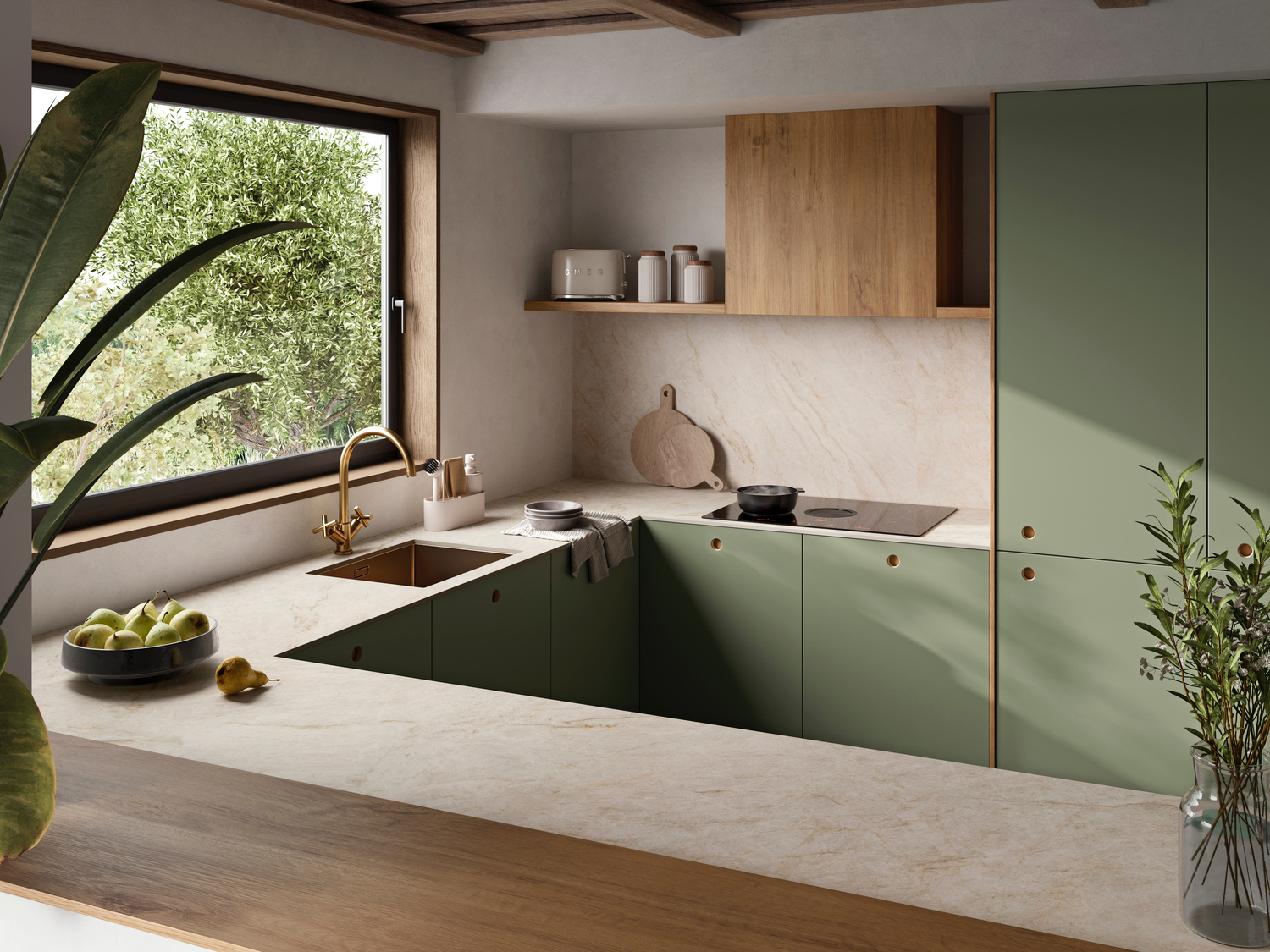
Neolith is made entirely from natural minerals, including granite, glass, silica, and natural oxides, with no plastic resins anywhere in its composition. It mimics the earth’s natural tectonic processes to produce a surface that is as durable as it is beautiful. Some standout features:
- Its 98R technology incorporates 98% recycled materials into specific models without sacrificing any structural integrity
- Zero porosity and a resin-free makeup earned it GREENGUARD Gold certification, meaning it emits zero VOCs into your home
- Highly resistant to heat, scratches, and UV rays
- Carbon Neutral since 2019, with Cradle to Cradle Certified® Bronze credentials and a zero waste manufacturing policy
Silestone by Cosentino
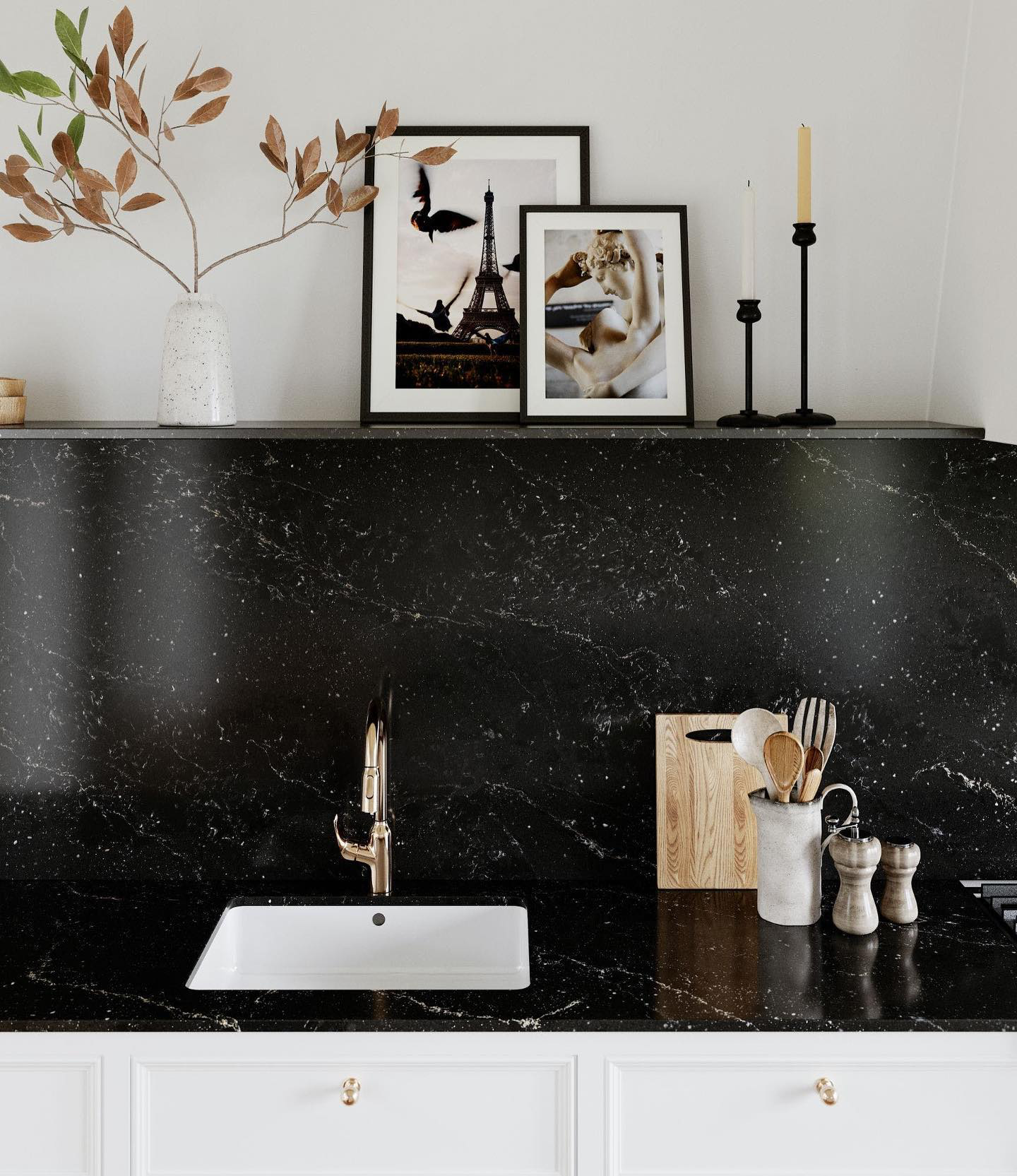
Silestone has long been the gold standard for premium quartz in the US, and its latest generation raises the bar on sustainability without giving up anything on aesthetics.
- HybriQ+® technology drastically reduces crystalline silica content, capping it at 40% and as low as 10% in the newer SilestoneXM lines, protecting the craftspeople who fabricate and install the stone
- Manufactured using 99% recycled water and 100% renewable electric energy, with zero water discharge into rivers or oceans
- The Earthic collection incorporates up to 30% recycled components, including PET, recycled glass, and bio-resins, while keeping its carbon footprint remarkably low
Dekton by Cosentino
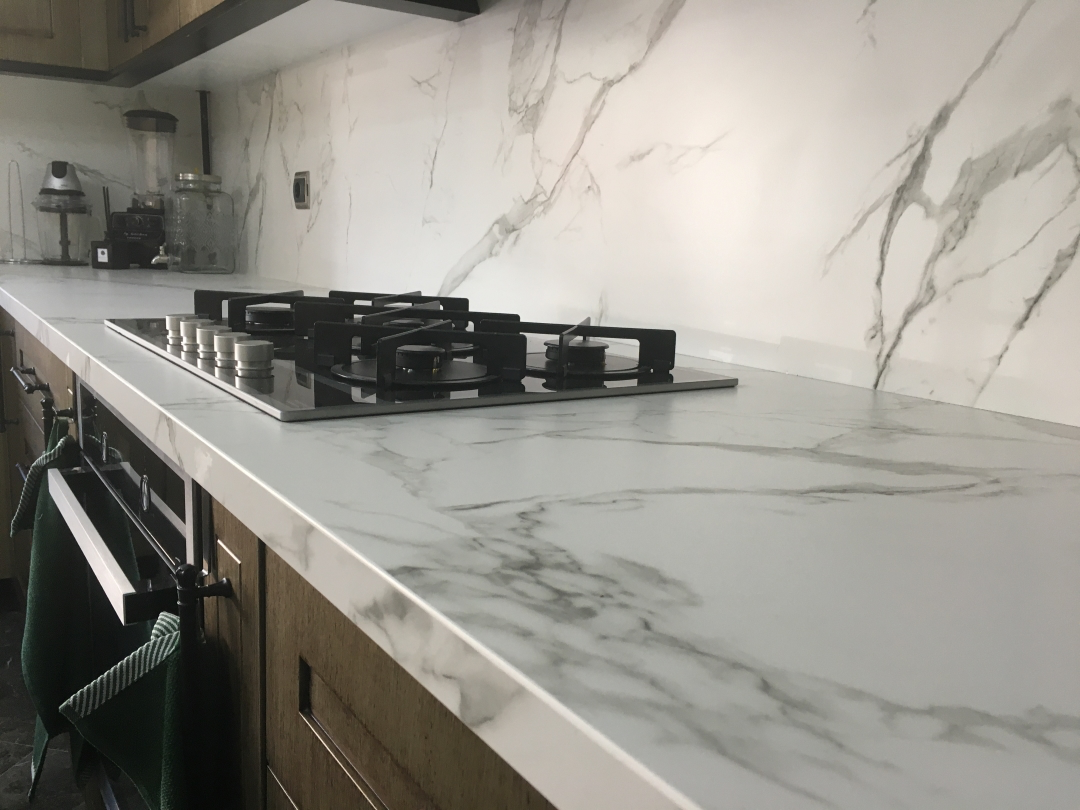
Dekton is the only surface on the market certified as Carbon Neutral from cradle to grave, covering every phase of its life from raw material extraction all the way through end of life.
- Backs its environmental claims with published Life Cycle Assessments and an International Environmental Product Declaration, making it a top choice for LEED-certified projects
- Immune to thermal shock, UV fading, and aggressive staining thanks to its ultra-high compression manufacturing process
- Holds GREENGUARD Gold certification, guaranteeing clean indoor air quality for your household
Beyond Sintered Stone: Other Eco-Friendly Materials Worth Considering
The category extends well beyond sintered stone for homeowners looking for a different kind of character in their space. It is also worth noting that natural stone itself carries genuine sustainability credentials — its minimal processing requirements, extreme longevity, and potential for recycling make it a strong choice for eco-conscious projects.
- Recycled glass and bio-resin countertops divert post-consumer waste from landfills by embedding crushed glass into bio-resins or concrete binders. They offer a striking terrazzo-like aesthetic, solid durability, and strong resistance to heat and scratches.
- Recycled paper composites are made from post-consumer recycled paper bound with petroleum-free resins. Once installed, they hold up like solid stone. They emit no dangerous VOCs, resist bacterial staining and heat, and carry a warm matte finish that suits contemporary interiors well.
- Reclaimed wood and bamboo serve homeowners who want genuine warmth in their kitchen. Reclaimed wood salvaged from old barns or wine barrels brings history and texture without any new logging. Bamboo is a rapidly renewable grass that regrows in three to five years, producing a surface that is naturally water-resistant and surprisingly stronger than oak.
- Recycled stainless steel countertops often contain up to 90% recycled content and carry a carbon footprint up to 75% smaller than the global industry average. Stainless steel is infinitely recyclable, hygienic, and low maintenance, which is why it has been a staple in professional kitchens for decades.
- Eco-friendly concrete and terrazzo countertops are now formulated with recycled aggregates and non-toxic sealers. When embedded with recycled glass or stone chips, they become elegant terrazzo surfaces with extreme longevity and strong visual customization potential.
See These Surfaces in Person
Reading about materials is one thing. Seeing them in person, touching the texture, and comparing slabs side by side is what actually makes the decision clear.
At Elements Room, you can explore Neolith, Silestone, Dekton, and a curated range of natural stone options with guidance from a team that knows the difference between materials that look great in photos and surfaces that perform beautifully for years. Visit our showroom in Los Angeles or San Antonio and see exactly what the right countertop can do for your space.