
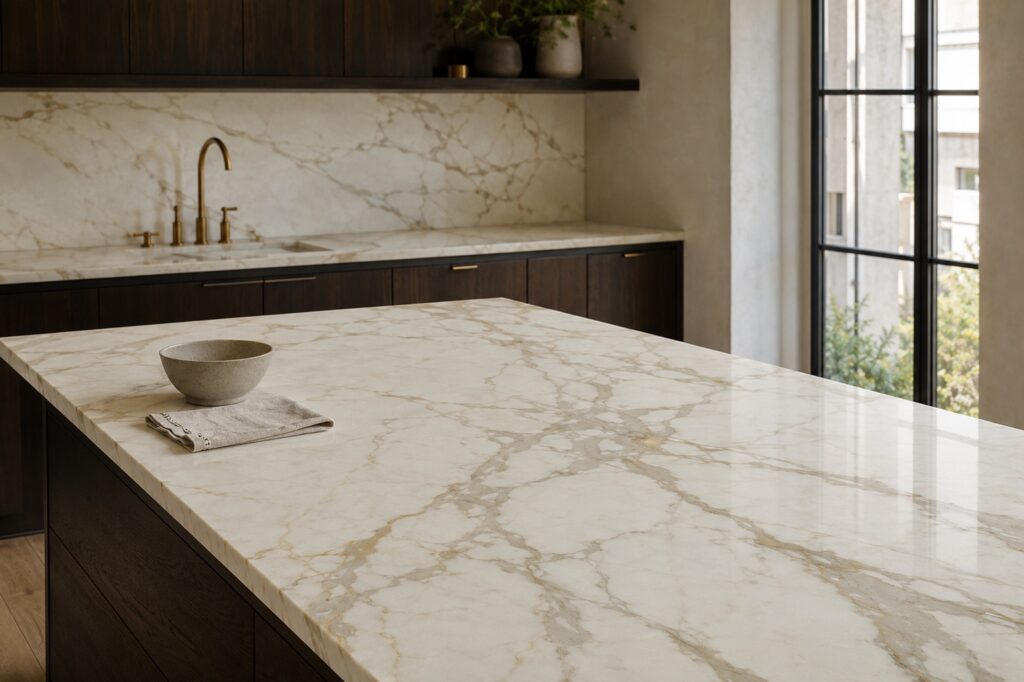
Calacatta Gold is, most of the time, an engineered quartz. It reproduces the look of Italian Calacatta marble, a bright white background crossed by warm gold and grey veining, on a surface that shrugs off the stains and etching that make real marble a worry in a kitchen. That is why it became one of the most requested white countertop looks, and why it usually costs a fraction of the natural stone it imitates.
The catch is that “Calacatta Gold” is not one product. It is a look sold by several brands, each with its own veining, finishes, and strengths. Elements Room carries it in quartz through Silestone and in porcelain through Atlas Plan, alongside natural marble.
Below is a practical, brand-by-brand guide: what it is, what each version offers, where it works in a kitchen, and how to style it.
The Main Calacatta Gold Options, Brand by Brand
Because the veining and performance change from maker to maker, the brand matters as much as the name. Here are the versions worth knowing, including the two Elements Room carries.
Silestone Eternal Calacatta Gold (Silestone by Cosentino)
The best-known quartz version. Silestone describes it as “a white background through which elegant, wide grey highlights are interspersed with unexpected golden glints.” It is built on Cosentino’s HybriQ technology, a hybrid of minerals and recycled materials, and the brand rates it for high scratch resistance, high impact resistance, and stain and acid resistance thanks to its low porosity.
Per Cosentino’s own spec sheet, it comes in Polished and Suede (soft matte) finishes, in 1.2, 2.0, and 3.0 cm thicknesses, at a slab format of about 127 by 63 inches. That 3 cm option is the one most US fabricators use for a solid, high-end countertop edge. Elements Room stocks Calacatta Gold within its Silestone range.
Atlas Plan Calacatta Gold (Porcelain)
The porcelain route, and the most versatile for whole-kitchen work. Atlas Plan produces Calacatta Gold as a sintered porcelain in very large formats, up to roughly 159 by 324 cm, in 6, 12, and 20 mm thicknesses, with bookmatch available. Porcelain is non-porous, food-contact safe, and water resistant, and unlike quartz it handles heat and UV, so the same slab can run from a countertop up a full wall or out to a covered patio.
Elements Room carries it through Atlas Plan.
What Colors Are in Calacatta Gold Countertops?
Across every version, the signature is a bright, milky-white background carried by two vein colors: a warm gold or honey, and a cooler grey. The balance is what changes. Silestone Eternal Calacatta Gold reads white with wide grey veins and golden glints. Some slabs stay subtle and linear, others run bold and river-like.
That warm gold thread is what separates Calacatta Gold from cooler whites like Carrara or Statuario. If you want the veining to read warm in your kitchen, view the actual slab, since screens shift the gold toward yellow or grey depending on the display.
Where to Use Calacatta Gold in the Kitchen
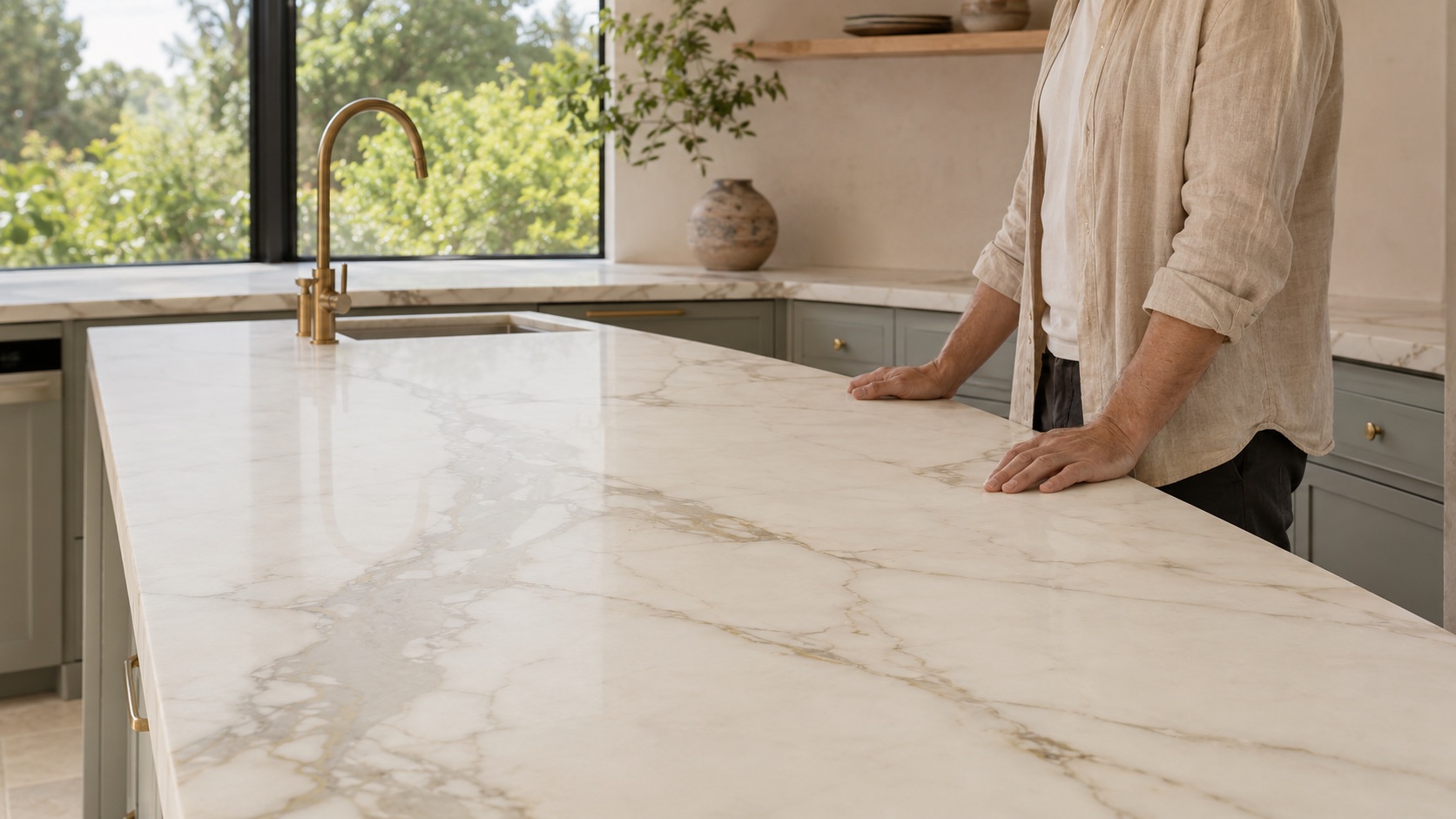
This is where the material choice pays off, because the same look can do very different jobs.
-
Perimeter countertops. The everyday workhorse. Quartz is ideal here: non-porous, no sealing, and it takes daily cooking without etching.
-
Island and waterfall. A Calacatta Gold island is the natural focal point, and running the slab down the sides as a waterfall shows the veining vertically. Bookmatched slabs, where two pieces mirror each other, make the veins flow across the seam.
-
Full-height backsplash. Running the same slab from counter to hood removes grout lines and lets the veining carry the wall. It is one of the most requested luxury backsplash treatments, and a slab backsplash reads calmer than busy tile.
-
Breakfast bar or peninsula. The same countertop material extended into a seating ledge keeps the look continuous and gives you a durable, wipe-clean eating surface.
-
Two-tone kitchens. Calacatta Gold on the island with a quieter surface on the perimeter (or the reverse) is a common way to feature the veining without wrapping the whole room in pattern.
-
Outdoor kitchens and full cladding. This is porcelain territory only. Because Atlas Plan porcelain is UV-stable and heat resistant, it can run from an indoor counter out to a covered outdoor kitchen, or floor-to-ceiling as cladding, in a way quartz cannot. Quartz is an indoor material; direct sun can discolor it over time.
A quick material rule for the kitchen: choose quartz for indoor counters and islands, and porcelain when the design crosses into heat, sun, or wall-and-floor cladding.
How to Style Calacatta Gold
The veining is warm, so build the room around that.
-
Cabinets: Calacatta Gold pairs beautifully with beige, off-white and medium greige, since each of these shares or complements the stone’s warmth, while also creating handsome contrast against darker cabinetry or natural timber.
-
Backsplash tile: If you do not run a slab, a warm-white zellige or a simple subway keeps the palette calm. A gold-veined marble-look tile also works; match the vein temperature, not just the color.
-
Floors: Warm wood, such as white oak, is the surest match. If you prefer tile, warm beige or greige reads better than a cool concrete grey.
Keep the whole palette warm. Cool grey-blue walls and stark cool-white cabinets tend to make the gold veining look muddy.
See Calacatta Gold in Person
Renderings flatten stone, and a small sample never shows a full slab’s movement. Because the gold-to-grey balance shifts from brand to brand and slab to slab, comparing options against your cabinets and light matters.
Elements Room carries the Calacatta Gold look in Silestone quartz in San Antonio showroom and Atlas Plan porcelain, at its Los Angeles and San Antonio showrooms.