
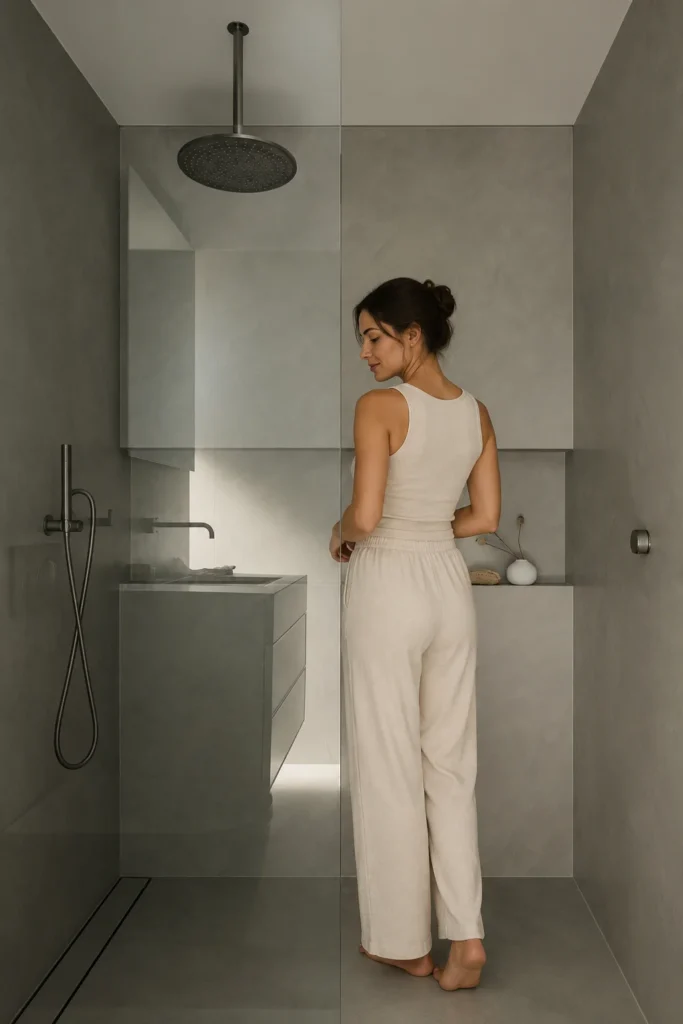
Dekton shower walls are large-format sintered-stone panels installed as a virtually groutless alternative to traditional tile. The slabs are non-porous, mold-resistant, UV-stable, and available in thicknesses from 4mm (Slim format) up to 12mm, large enough to wrap a full shower in two or three pieces. Installed cost typically runs $60 to $150 per square foot, depending on slab, edge details, and fabricator.
Elements Room carries Dekton at our Los Angeles and San Antonio showrooms, and our team works with designers and fabricators specifying it for showers and full bathroom cladding. Below is the dealer’s checklist: what works, what to plan for, and what to expect on price.
Why Dekton Works for Shower Walls
A shower is a hostile environment for surface materials. Constant moisture, soap films, hot water, and daily scrubbing wear down anything porous. Dekton’s composition, an ultracompact porcelain made through Cosentino’s TSP sintering process, is engineered for exactly this kind of duty. At Elements Room, this is the brand we point to first when designers come in asking about groutless shower options.
From what we see on the showroom floor, four properties make the difference:
-
Zero porosity. Water cannot penetrate the surface, so there’s nothing for mold or mildew to colonize.
-
Virtually groutless. Slabs are large enough to wrap a full shower wall in one or two pieces, dropping joint count from dozens to two or three.
-
No sealing required. Unlike natural stone, Dekton stays waterproof for the life of the installation.
-
Resistant to common bathroom chemicals. Soap, shampoo, hair dye, and household cleaners do not stain or etch the surface.
Thicknesses and Formats
The right thickness depends on the application and the fabricator’s preference. Cosentino’s bathroom cladding catalog lists three primary options, and Elements Room stocks rotating selections across all three for the LA and SA markets.
4mm. Dekton Slim and Optimma
The slimmest format. The Optimma format (2,600 × 1,000mm, 4 or 8mm) is engineered specifically for vertical cladding: lighter, easier to cut, and sized to match standard shower wall heights. This is the format most fabricators recommend for shower surrounds.
8mm. Standard Cladding Thickness
A common middle ground. Heavier than Slim, more forgiving in fabrication, suitable for full-height bathroom walls and shower enclosures.
12mm. Heavy-Duty Cladding
Used when the wall doubles as structural cladding, in commercial showers, or where the same Dekton color runs from wall to bench to threshold.
Slab sizes available:
| Format | Dimensions | Typical use |
|---|---|---|
| Standard | 3,200 × 1,440 mm | Full-wall cladding, larger showers |
| Jumbo | 3,300 × 1,630 mm | Two-piece full bathrooms |
| Optimma | 2,600 × 1,000 mm | Standard shower wall heights |
For most residential showers, two Optimma panels in 8mm (one per wall) can finish the entire enclosure with a single visible joint per corner.
Finishes and Colors for Bathrooms
Dekton offers five core textures, each available across most of the catalog:
-
Matte. Natural, harmonious look. Hides water marks. Most-specified for shower walls.
-
X-Gloss. Polished, luminous. Bounces light in small bathrooms but shows water spots more.
-
Velvet. Warm, soft touch. Mid-sheen.
-
Textured Matte / Velvet. Surface with deliberate imperfections, more natural-stone-like read.
-
Ukiyo. Grooved patterns by designer Claudia Afshar. More commonly used on vanity walls than wet shower walls.
Cosentino’s most-requested bathroom colors are Nara, Ava, Laurent, Awake, Marmorio, and Rem. From the Pietra Kode collection, Marmorio and Sabbia run especially strong in spa-style bathrooms. .
Installation: What Your Fabricator Needs to Know
Dekton’s density is what makes it bulletproof in service, and what makes it demanding to install. The Cosentino installation guide, plus the projects Elements Room has helped specify, point to four non-negotiables:
Certified fabricator. Dekton requires specialized tools (continuous-rim diamond blades, water-cooled saws). General tile installers without Dekton certification often crack slabs.
Substrate prep. Walls must be plumb, dry, and structurally sound. Cement board or fiber cement panels are standard. Drywall alone is not acceptable behind a Dekton shower wall.
A-frame transport. Large-format slabs flex when carried flat and crack. Professional A-frames are mandatory from slab yard to install site.
Waterproofing at joints. Even with minimal joints, the seams must be sealed with a flexible, mold-resistant, sanitary-grade silicone. A wall membrane behind the substrate is standard for any wet area.
For deeper material comparison context, see our Dekton vs Quartz guide. For competing large-format sintered options, we also carry Neolith and Caesarstone Porcelain.
Where Elements Room Fits In
For a shower-walls-only project, Elements Room is your direct line to current Dekton inventory in Los Angeles and San Antonio.
For projects that combine Dekton with other porcelain brands or natural stone, Elements Room can plan the material mix and edge details in a single showroom visit.
Frequently Asked Questions
How thick is a Dekton shower wall?
Standard shower-wall thicknesses are 4mm (Dekton Slim / Optimma), 8mm, and 12mm. Most fabricators recommend 8mm Optimma for residential showers: lighter than 12mm, more forgiving than 4mm Slim.
Is Dekton good for showers?
Yes. Dekton is non-porous, UV-stable, and resistant to common bathroom chemicals. Because slabs are large enough to wrap a shower in two or three pieces, grout (the weak point in traditional tiled showers) is reduced to a handful of silicone seams.
Where can I see Dekton shower walls in person?
Elements Room displays current Dekton slabs at both our Los Angeles and San Antonio showrooms. Visit to see real slab dimensions, finishes, and edge samples before committing.